Fatty15 Dosage: How Much C15 to Take, When, and How
Fatty15 keeps dosing simple, one capsule (or gummy serving) per day, but there are a few practical details that help it work as intended and minimize any stomach upset. Here’s a straightforward guide to how much C15 to take, timing, and what to expect.
Fatty15 discount code: SFKKDBQQ takes 20% off at fatty15.com (minimum $20 order). Open Fatty15 with the 20% discount. We earn a commission if you buy through this link, at no extra cost to you.
The Standard Fatty15 Dose
Fatty15 is formulated as a once-daily dose delivering a standardized amount of pure C15 (pentadecanoic acid). Fatty15 suggests starting with one capsule a day, and C15 is thought to build up in cell membranes gradually, so a consistent daily routine is the sensible approach.
Research note: In the Food4Me study, blood C15:0 was fairly stable within a person over six months (ICC 0.62, 95% CI 0.57 to 0.68), while C17:0 was much less stable (ICC 0.32, 95% CI 0.28 to 0.46) [8].
When to Take Fatty15
Take it with food or on an empty stomach. Fatty15’s FAQ says either works, and no direct evidence shows that a meal improves absorption. If it upsets your stomach when taken empty, taking it with a meal is a reasonable adjustment. Time of day is flexible, morning or evening is fine; consistency is what counts.
How Much Is Too Much?
More is not better. There’s no established benefit to megadosing C15, and no study has shown that doubling up helps. Stick to the recommended serving unless a clinician advises otherwise.
How Long Until It Works?
Fatty15 says C15 builds up in cell membranes over weeks to months, but that comes from the company and lab work, not from a human trial of the capsule. Either way, there’s no immediate “felt” effect to expect [1]. If you want to confirm it’s raising your levels, testing your C15 blood level before starting and again after a few months is the most objective approach. Patience and consistency beat expecting a quick hit.
Dosage for Generic C15 Supplements
If you use a generic pentadecanoic acid supplement instead of the branded product, check the label for the per-capsule C15 amount and match a comparable daily dose. The molecule is the same; just confirm you’re getting an adequate, comparable amount.
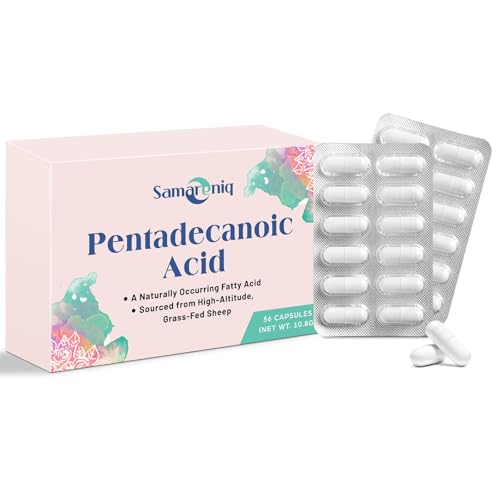

To see what a dose costs over time, pick one or two capsules a day and how many days you want to plan for. The calculator below shows how many 90-count bottles that takes and the estimated total, using the bottle price stated in the tool; check the current price before buying.
C15:0 Dosage & Cost Calculator
Based on the labeled dose options for fatty15. You set the bottle price and size.
Open the full dosage & cost calculator →
Enter the bottle price you see to get your own numbers.
Estimate only – worked out from the price and bottle size above. Prices change; check the current price before buying.
Why no height/weight input? Unlike per-kg supplements (creatine, protein), C15:0 has no published bodyweight-adjusted dosing in the research behind it. This calculator doesn't fabricate a per-kg formula that doesn't exist in the literature.
Get 20% off fatty15 with code SFKKDBQQ(paid link) We're an affiliate partner of Fatty15 and earn a commission if you buy through this link.
What the Brand Says About Capsules Per Day
Fatty15’s own FAQ and product page, read in October 2026, give a more detailed picture than a simple one-a-day rule. The original capsule contains 100 mg of the company’s pure powder ingredient, with no fillers. The FAQ recommends that customers start with one capsule a day, and says some customers choose two, noting that safety studies have been completed for up to 250 mg, which it equates to about two and a half capsules. The product page itself says to start with one or two capsules. The FAQ also says long-term cellular benefits can take three to six months of routine use, while the brand’s marketing describes near-term effects within a few weeks.
The 250 mg safety statement is a company claim, and no published study matching it turned up in a PubMed search for this update, so treat it as the brand’s own threshold rather than an independently established limit. The same goes for the brand’s report that constipation, diarrhea or headache occurred in fewer than 0.1 percent of customers, which the FAQ says may not be caused by the product.
With Food or on an Empty Stomach?
A common instruction in articles about C15 is to take it with a fat-containing meal, because it is a fatty acid. Fatty15’s FAQ takes a different position: it says the capsule can be taken either with food or on an empty stomach, and that many customers take it in the morning while others take it in the evening to support sleep. It also says the capsule contains only one calorie, so it should not break an intermittent fast. The brand does not claim that food improves absorption.
The published human pharmacokinetic data are limited and indirect. A 2013 pilot study in the International Journal of Clinical Pharmacology and Therapeutics (Stallings et al.) used pentadecanoic acid as a marker for fat absorption. Participants, 15 healthy adults and adolescents with cystic fibrosis, ate a test breakfast containing pentadecanoic acid plus a triglyceride made of heptadecanoic acid, and blood levels were tracked over several hours [4]. Blocking the pancreatic enzyme lipase with Orlistat cut absorption of the triglyceride-bound fatty acid by about 71 percent at peak, but absorption of the free pentadecanoic acid was unchanged, and in people with cystic fibrosis it did not differ with or without enzyme therapy. In plain terms, the free fatty acid did not depend on fat-digesting enzymes to be absorbed in that setting. Two cautions apply: the dose was far larger than a 100 mg capsule [4], and the study did not compare eating against fasting. It tells us free C15 is readily absorbed, not whether a meal changes how much of a 100 mg capsule reaches the blood.
The practical takeaway is that the strict instruction to take it only with food is not supported by the brand or by direct evidence. If you notice mild stomach upset on an empty stomach, taking it with a meal is a reasonable personal adjustment, but that is trial and error, not a proven requirement.
What Doses Have Been Tested in People
Published human dosing data are thin. The 2024 randomized trial in the Journal of Nutrition (Robinson et al.) used 200 mg of C15 daily for 12 weeks in 30 young adults with overweight or obesity, 20 on the supplement and 10 on placebo. Circulating C15 rose 1.88 micrograms per mL more in the treated group than in the placebo group, no significant adverse events occurred, and half of the treated participants ended with levels above 5 micrograms per mL. By weight, 200 mg corresponds to two 100 mg capsules, though the abstract does not name the product used. Because the trial tested only one dose against placebo, it cannot tell you whether 100 mg, 200 mg or 250 mg is better, or whether the half of participants who stayed below 5 micrograms per mL would have crossed that line on a higher dose.
A 2024 randomized trial in the American Journal of Clinical Nutrition (the TANGO trial) [3] added C15 to a Mediterranean-style diet in 88 Chinese women with fatty liver disease for 12 weeks. The abstract reports that the C15 group had a further drop in LDL cholesterol compared with diet alone, but does not state the dose, so it cannot be used to benchmark capsule counts.
Blood Levels, Diet and Why Doses Differ Between People
Two people taking the same capsule can end up with different blood levels. A 2016 review in Advances in Nutrition (Pfeuffer and Jaudszus) explains that pentadecanoic acid is a recognized marker of dairy fat intake, yet it can also be made in the body from gut-derived propionic acid. Baseline diet, gut microbiota, body size and supplement adherence could all affect where someone starts and finishes. In the 2024 trial, the fact that only half of the treated group passed the 5 microgram threshold is consistent with that variability. It also makes the case that measuring a blood level, if a clinician offers a fatty acid panel, would be more informative than counting capsules. The brand does not require testing, and this article cannot say how widely such tests are available.
Dairy moves blood C15 only a little, and healthy people start far apart
A small rise
After four weeks on a dairy diet, plasma 15:0 was 0.26% of total fatty acids versus 0.22% on the control diet.
Only the top dairy group
Red blood cell C15:0 rose by 0.37 µg/ml, and only at 12 months in the group eating the most dairy.
No group difference
Extra dairy made no difference to serum 15:0 or 17:0 compared with the low-dairy group.
A wide starting range
Mean plasma 15:0 was 17.8 µmol/L, with reported percentiles from 10.8 to 26.3.
Two people on the same intake can sit at quite different blood C15, so a number on a label says little about where you will land.
Dairy feeding trials and a population survey, not supplement trials. Units differ between studies, as labelled. Source: British Journal of Nutrition 2015; Prostaglandins, Leukotrienes and Essential Fatty Acids 2019; British Journal of Nutrition 2022; PLoS ONE 2015.
Chart: c15hub.com: Dairy moves blood C15 only a little, and healthy people start far apart
Embed this chart
Free to reuse on your site. Copy the code below; please keep the credit link.
Timing, Consistency and What to Track
- Pick a routine you will keep. Morning versus evening is a preference. The brand reports effects building over weeks to months, so the habit matters more than the clock time.
- Give it a fair window. The only trial that gave C15 on its own against placebo ran 12 weeks, which is a sensible minimum before judging any change [2][3].
- Change one thing at a time. If you add a second capsule, keep the rest of your supplement routine the same.
- Check with a clinician if relevant. The brand says it has not identified contraindications with other supplements or prescription medications and says it is safe in pregnancy and nursing under its GRAS status. Those are company statements. If you are pregnant, nursing or on medication, ask your own clinician instead of relying on them.
Those company statements are not pregnancy studies. In pregnant mice, a C15-enriched diet caused mild insulin resistance, and in obese pregnant mice it caused mild glucose intolerance. In mother-infant pairs, higher red blood cell C15 was seen in small-for-gestational-age babies. These are animal and observational findings, not proof of harm, which is why a clinician should weigh in [5][6][7].

Frequently Asked Questions
How many Fatty15 should I take per day?
One serving per day (one capsule or the labeled gummy serving) is the standard dose. Consistency matters more than quantity, since Fatty15 says C15 builds up in cell membranes over time (a company claim, not shown in a human trial) [1].
Should I take Fatty15 with food?
It can be taken with food or on an empty stomach, according to the brand. No direct evidence shows that a meal improves absorption; if it upsets your stomach when taken empty, taking it with a meal is a reasonable adjustment.
What’s the best time to take Fatty15?
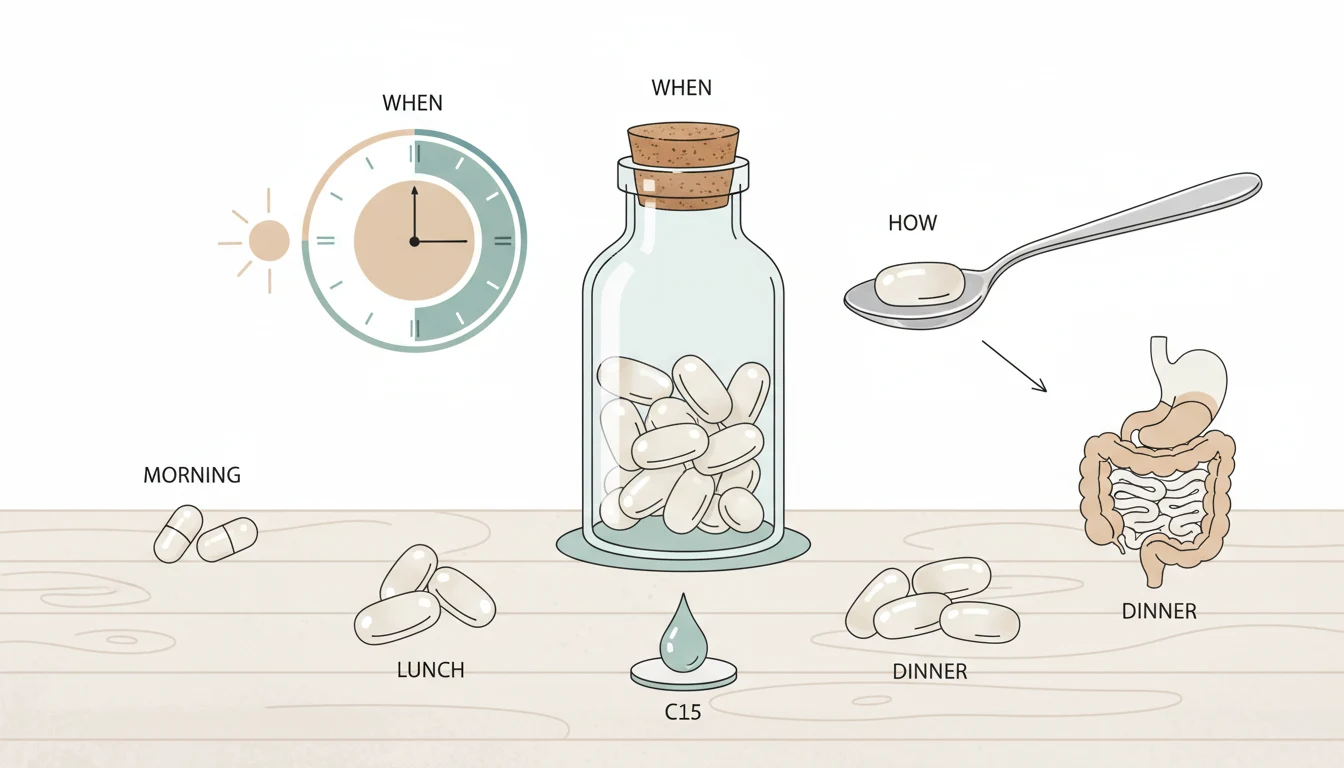
Time of day is flexible, morning or evening both work. Take it with food or without, as the brand says either works, and keep it consistent day to day.
Can I take more than one Fatty15 a day?
There’s no established benefit to higher doses, and no study has compared doses. Stick to the recommended serving unless your clinician advises otherwise.
Can I take Fatty15 on an empty stomach?
Yes, according to the brand. Its FAQ says the capsule can be taken with food or without. One small 2013 study found free pentadecanoic acid was absorbed without needing fat-digesting enzymes, but no study has compared fed against fasted dosing for a 100 mg capsule.
Is two capsules a day better than one?
Unknown. The brand starts people at one capsule and says some take two, with safety studies up to 250 mg. The only published trial of C15 on its own against placebo used 200 mg daily and did not compare doses [2][3], so there is no evidence that two is better than one.
How long should I take it before judging results?
The 12-week trial duration is a reasonable minimum, and the brand says long-term effects can take three to six months. A blood C15 test, if your clinician can order one, is the most objective check.
References
- Robinson MK et al. Pentadecanoic Acid Supplementation in Young Adults with Overweight and Obesity: A Randomized Controlled Trial. The Journal of nutrition (2024). PMID 39069269
- Venn-Watson S et al. Efficacy of dietary odd-chain saturated fatty acid pentadecanoic acid parallels broad associated health benefits in humans: could it be essential? Scientific reports (2020). PMID 32424181
- Stallings VA et al. Diagnosing malabsorption with systemic lipid profiling: pharmacokinetics of pentadecanoic acid and triheptadecanoic acid following oral administration in healthy subjects and subjects with cystic fibrosis. International journal of clinical pharmacology and therapeutics (2013). PMID 23357842
- Pfeuffer M et al. Pentadecanoic and Heptadecanoic Acids: Multifaceted Odd-Chain Fatty Acids. Advances in nutrition (Bethesda, Md.) (2016). PMID 27422507
- Chooi YC et al. Effect of an Asian-adapted Mediterranean diet and pentadecanoic acid on fatty liver disease: the TANGO randomized controlled trial. The American journal of clinical nutrition (2024). PMID 38035997
Related: Fatty15 Side Effects · Does Fatty15 Work? · Fatty15 Review
References
- Mercola J Molecular and cellular mechanisms of pentadecanoic acid. World journal of biological chemistry (2025). PMID 41378251
- Robinson MK et al. Pentadecanoic Acid Supplementation in Young Adults with Overweight and Obesity: A Randomized Controlled Trial. The Journal of nutrition (2024). PMID 39069269
- Chooi YC et al. Effect of an Asian-adapted Mediterranean diet and pentadecanoic acid on fatty liver disease: the TANGO randomized controlled trial. The American journal of clinical nutrition (2024). PMID 38035997
- Stallings VA et al. Diagnosing malabsorption with systemic lipid profiling: pharmacokinetics of pentadecanoic acid and triheptadecanoic acid following oral administration in healthy subjects and subjects with cystic fibrosis. International journal of clinical pharmacology and therapeutics (2013). PMID 23357842
- Cinelli G et al. Association between Maternal and Foetal Erythrocyte Fatty Acid Profiles and Birth Weight. Nutrients (2018). PMID 29570689
- Wang J et al. Pentadecanoic acid (C15:0, PA) induces mild maternal glucose intolerance and promotes the growth of the offspring partly through up-regulating liver PPARα and MAPK signaling pathways. Food & function (2024). PMID 39434548
- Wang C et al. Pentadecanoic acid (C15:0) promotes placental angiogenesis by activating the placental PI3K-AKT signaling. Food & function (2025). PMID 41221667
- Albani V et al. Within-person reproducibility and sensitivity to dietary change of C15:0 and C17:0 levels in dried blood spots: Data from the European Food4Me Study. Molecular nutrition & food research (2017). PMID 28544702
These statements have not been evaluated by the Food and Drug Administration. This information is not intended to diagnose, treat, cure, or prevent any disease. Content is for informational purposes only and is not medical advice; consult a qualified healthcare provider before starting any supplement. As an Amazon Associate we earn from qualifying purchases.