Fatty15 Side Effects: What to Know Before You Take It
Fatty15 delivers a single ingredient, C15 (pentadecanoic acid), a fatty acid found naturally in whole-fat dairy and some fish. The limited research to date found no significant adverse events in one small trial, and the brand reports very few side effects, though that figure is self-reported [1][11]. Still, no supplement is completely without possible side effects, and it’s worth knowing what to watch for and how to minimize any issues.
Is Fatty15 Safe?
C15 is a naturally occurring dietary fatty acid, and limited toxicology work and one small human trial found no significant adverse events at the doses studied. C15 does occur in food, but Fatty15 says its capsule ingredient is made by chemical synthesis, and a 100 mg capsule holds more than the roughly 20 mg in a 200 ml glass of semi-skimmed milk, so food exposure is not proof that capsule doses are safe [11][12]. That said, “generally safe” is not the same as “zero risk for everyone.”
The safety evidence is one small trial, animal data and company reports
No significant adverse events
30 young adults took C15:0 or placebo for 12 weeks. The maker supplied the capsules.
No adverse effects at 15% of diet
An odd-chain algal oil showed a NOAEL of 15% in the diet. Animal data, not human.
Under 0.1% of customers
Fatty15 says constipation, diarrhea or headache were reported in less than 0.1% of customers. Unverified.
C15:0 was toxic
In fission yeast, C15:0 formed abnormal ER sheets that blocked cell division.
No serious problems have shown up, but the human safety record is short and mostly company-supported.
Mixed designs from different sources; none is a long-term human safety study. Source: The Journal of Nutrition 2024; Food and Chemical Toxicology 2021; Fatty15 FAQ 2026; Proceedings of the National Academy of Sciences 2025.
Chart: c15hub.com: The safety evidence is one small trial, animal data and company reports
Embed this chart
Free to reuse on your site. Copy the code below; please keep the credit link.
Research note: In infants at high risk of childhood-onset autoimmune diabetes, higher serum pentadecanoic acid (15:0) was linked to a higher risk of islet autoimmunity (odds ratio 3.41). This runs opposite to popular C15:0 benefit claims; association in children [22].
Reported Fatty15 Side Effects
- Occasional mild complaints: Fatty15’s FAQ lists constipation, diarrhea or headache, each reported by a very small share of customers, and says it cannot confirm the supplement caused them.
- No consistent serious side effects: so far no pattern of serious side effects has been reported at recommended doses, but the evidence is one 12-week trial in 30 adults plus the seller’s own customer reports [1][11].
- Individual sensitivity: as with any supplement, a small number of people may simply not tolerate it well.
How to Minimize Side Effects
- Take it however suits you: Fatty15’s FAQ says the capsules can be taken with food or on an empty stomach. If your stomach is upset either way, ask a clinician.
- Start consistently at the recommended dose rather than doubling up.
- Give it time, and do not assume more is better; there is no evidence that megadosing helps.
For dosing specifics, see our Fatty15 dosage guide.
Who Should Be Cautious
Anyone who is pregnant or breastfeeding, has a medical condition, or takes prescription medication should talk to a clinician before starting Fatty15 (or any new supplement). This is standard caution rather than a specific known interaction, C15 does not have a well-documented list of drug interactions, but personalized medical advice always wins.
Groups the Research Has Not Covered
The one human supplementation trial enrolled young adults with overweight or obesity (mean age 20.0), so several groups have no direct safety data at all:
- Children and adolescents: no supplementation trial has enrolled them, so dose, safety and developmental effects are unknown. Use in minors belongs under a clinician’s supervision.
- Kidney transplant recipients and people with kidney disease: a 2024 Nutrients study of 25 patients tracked serum fatty acids before transplant and again at 3 and 6 to 12 months, and found odd-chain fatty acids increased over the longer term [6]. That describes how the body’s own fatty acid profile shifts after a transplant, not a supplement trial. How a C15 capsule behaves alongside immunosuppressants or reduced kidney function has not been studied, so this group should ask their transplant or kidney team first.
- People with fatty acid oxidation or lipid disorders, or liver disease: none of the studies above enrolled them, so it is unknown how they respond. A specialist should weigh in.
- People on medications that act on the AMPK or mTOR pathways, such as metformin or rapamycin: one cell-based paper from researchers affiliated with the ingredient’s developer reports that C15 activates AMPK and inhibits mTOR [7]. No drug interaction has been documented, and a cell-assay finding is not evidence of one. It is simply a reason to mention C15 to the prescriber.
Fatty15 vs Generic C15: Same Side-Effect Profile
Because the active ingredient is the same molecule, a generic pentadecanoic acid supplement would be expected to have a similar side-effect profile to branded Fatty15, although this has not been compared directly. Quality, testing and source differ between products, but the fatty acid itself is the same molecule. See our Fatty15 alternatives guide if you’re comparing options.
Muscle is another open question. A study of human muscle samples and cultured cells found pentadecanoic acid had accumulated in the muscles of people with sarcopenia and triggered cell-death signalling in vitro, and two Mendelian randomization studies linked genetically higher C15 to lower lean mass. None of this shows a supplement causes harm, but it is a reason not to assume that more C15 is better [19][20][21].
What Fatty15 Itself Reports About Side Effects
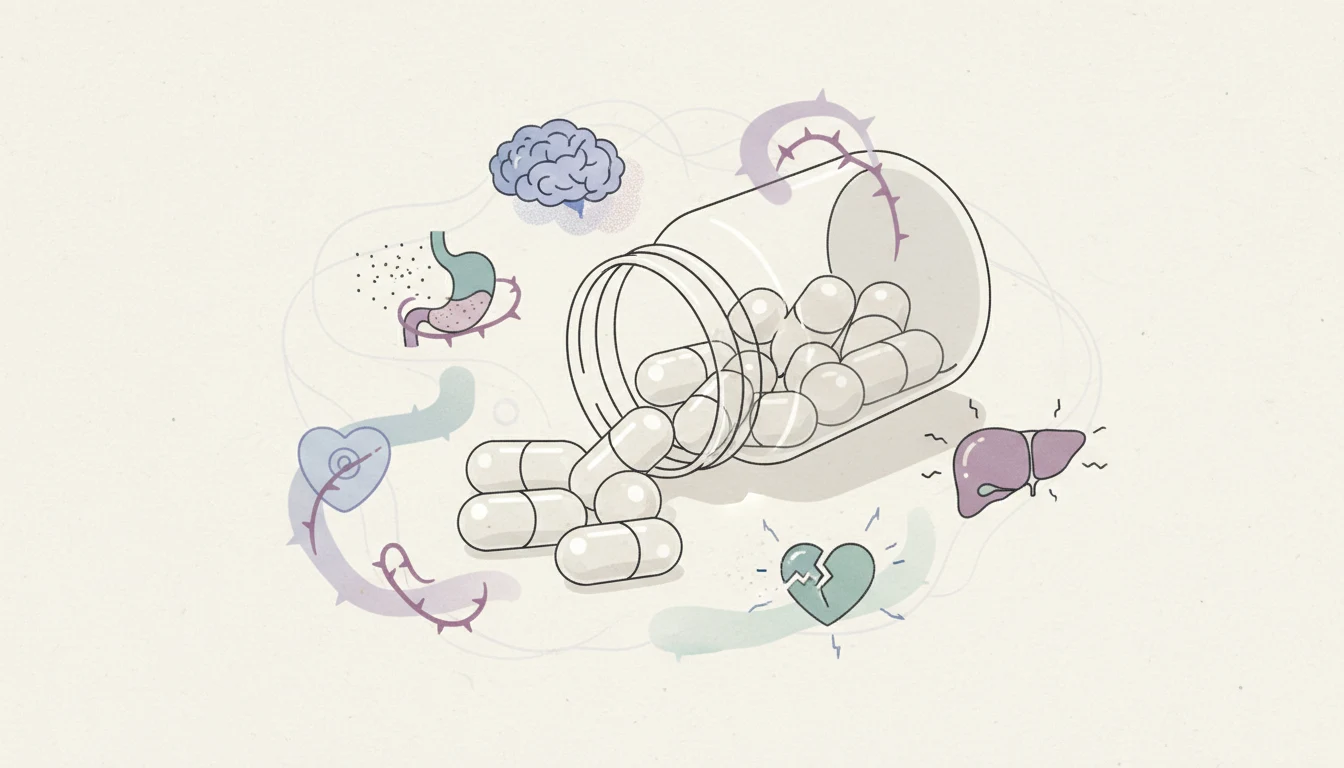
The brand’s FAQ addresses side effects directly. It says that since the ingredient reached the market in 2021, over 77,000 customers have taken Fatty15 with “very few side effects,” and that constipation, diarrhea or headache were reported by fewer than 0.1 percent of customers. It adds that it cannot confirm these were caused by the supplement. That is a self-reported, unaudited figure from the seller, so it is useful as a signal of what customers mention to customer service, not as a measured incidence rate. It is also worth noticing that the list is constipation, diarrhea and headache, which differs from the nausea-on-an-empty-stomach picture sometimes repeated online.
On timing, the FAQ says the capsules can be taken with food or on an empty stomach. The company also states that no specific contraindications with other vitamins, supplements or prescription medications have been identified, while encouraging customers to talk to a healthcare provider first. Treat “none identified” as an absence of reported problems, not as proof that interactions have been ruled out.
What the Human Trial Measured for Safety
The best human safety data comes from a 2024 randomized, double-blind trial in the Journal of Nutrition (Robinson et al.), which was supported by Seraphina Therapeutics, the company that supplied the capsules [1]. It gave 200 mg of pentadecanoic acid or placebo daily for 12 weeks to 30 young adults with overweight or obesity, with 20 people on the supplement and 10 on placebo. The authors report that no significant adverse events occurred. That is reassuring, and it is also a small study. A useful rule of thumb is that if nothing is seen in 20 treated people, the true rate of an event could still be as high as roughly 1 in 7 without the trial noticing (three divided by twenty is 15 percent). Rarer problems, longer-term effects, older adults, children and people with existing disease were simply not tested.
The same trial reported an unexpected pattern in people whose blood level rose above 5 micrograms per mL, with larger falls in liver enzymes and a rise in hemoglobin than in treated participants who stayed below that mark. The authors called these findings potentially relevant and in need of further study. Because they come from a comparison inside the treated group, they are a lead, not a verified benefit or a clean safety conclusion.
Animal and Cell Studies on Tolerability
Two other lines of evidence support general tolerability, with caveats. A 2021 paper in Food and Chemical Toxicology (Matulka et al.) tested an algal oil made mostly of pentadecanoic and heptadecanoic acids in rats. In a 13-week feeding study at 5, 10 and 15 percent of the diet, no adverse effects were attributed to the oil, giving a no-observed-adverse-effect level of 15 percent of the diet, equal to about 7,554 mg per kg of body weight a day in male rats and 8,388 mg per kg in females. The oil was also non-mutagenic in bacterial tests and did not damage chromosomes in a live-animal assay. This was a blend of two fatty acids, not the pure Fatty15 ingredient, and rats eating that much have little in common with a person taking 100 mg.
A 2022 PLOS One paper (Venn-Watson and Butterworth) tested pure pentadecanoic acid in 12 primary human cell systems at concentrations from 1.9 to 50 micromolar and found it non-cytotoxic at every concentration, while the omega-3 fatty acid EPA was cytotoxic to four cell systems at the highest dose. Cell results do not predict what happens in a body, and the authors disclose patents licensed to the company that sells the ingredient.
What Dairy-Biomarker and Related-Compound Data Add
C15 was studied as a marker of dairy fat long before capsules existed. In a Swedish cohort of 4,150 adults followed for a median of 16.6 years, higher serum C15 was associated with lower incident cardiovascular disease (hazard ratio 0.75 per interquintile range, 95% CI 0.61 to 0.93). A pooled analysis of 18 prospective cohorts, as summarised in a narrative review, reported 12 percent lower cardiovascular risk in the highest versus lowest fifth of C15 [13], and no association of dairy-fat biomarkers with all-cause mortality, though with three or fewer studies per biomarker [8]. This is background rather than proof of supplement safety: it reflects lifelong dietary exposure measured in blood, and people who eat more dairy differ from those who eat less in many other ways.
The cardiovascular signal is weaker in the largest US cohorts. In CARDIA and ARIC, plasma C15 was not associated with incident cardiovascular disease, and Mendelian randomization found no evidence that C15 causally affects blood pressure, heart rate or hypertension. The authors concluded the evidence is not consistent with a causal cardiovascular benefit of C15. A narrative review also reports null findings in UK Biobank and the Danish Diet, Cancer and Health Study [15][13].
A related compound offers a small digestive-tolerability signal. Triheptanoin is a synthetic seven-carbon triglyceride, not C15, used in a rare group of metabolic diseases. In a retrospective study of nine patients with long-chain fatty acid oxidation disorders, epigastric pain and diarrhoea were recorded as adverse effects on both standard MCT oil and triheptanoin [9]. The compound, population and dose (grams per kilogram per day) are all very different from a 100 mg capsule, so it cannot be read across directly. It does show that digestive complaints are the kind of effect to expect from concentrated lipid supplements.
A Pregnancy Question the Label Does Not Settle
Fatty15’s FAQ states that its ingredient has GRAS status and describes the product as safe for pregnant and nursing women. The published literature is thinner. A 2024 mouse study in Food and Function (Wang et al.) fed pregnant mice a diet containing 1 percent pentadecanoic acid. The treatment raised pentadecanoic and heptadecanoic acid in maternal and fetal tissue and had no effect on embryonic development. However, it also caused mild insulin resistance during pregnancy and lactation, mild oxidative stress during lactation, and faster offspring growth, along with lower triglycerides and higher antioxidant capacity in the offspring.
That study is in mice, uses a dietary percentage far above what a capsule delivers, and its authors framed the findings as mild. It does not show harm in pregnant women. But it is a reason the sentence “there isn’t specific safety data for pregnancy” is a fair reading of the human literature, and a reason anyone pregnant or nursing should clear any supplement with their clinician first, whatever the label says.
Human observational data on C15 and pregnancy point in different directions and do not settle the question. In 607 mother-infant pairs, higher red-blood-cell C15 was found in small-for-gestational-age babies, and in a breast-milk cohort higher C15 at 42 days was linked to lower infant motor development scores. A US cohort linked higher early-pregnancy C15 to larger fetal weight. All are associations, but none supports assuming that more C15 is safe in pregnancy [16][17][18].
Product Quality Is Part of Safety
Side effects depend on what is in the capsule as well as on C15. A 2012 PLOS One analysis of 121 natural health products found toxic-element contamination in many of them, with levels above established limits in only a small percentage, and some products above preferred daily endpoints for mercury, cadmium, lead, arsenic or aluminum [10]. It was not a C15 study, but it is a reason to prefer products that publish third-party purity testing and to read a seller’s own safety claims as marketing rather than an audit.
Where the Safety Evidence Runs Out
- Duration: the human trial lasted 12 weeks, while people are encouraged to take the supplement indefinitely.
- Population: young adults with overweight or obesity were studied, not older adults, people with kidney or liver disease, or those on multiple medications.
- Dose: the trial used 200 mg a day. The brand sells 100 mg capsules, recommends starting with one, and says safety studies have been completed up to 250 mg a day, a statement for which no matching published study was found.
- Independence: much of the supporting research comes from groups tied to the company, and no large independent safety trial has been identified in the sources reviewed.
None of this signals a hidden danger. It describes the edge of what is known, and that edge is the right place for a cautious reader to apply common sense: tell your clinician what you take, stop and ask for advice if something new appears after you start, and report persistent symptoms to a professional rather than waiting them out.


Frequently Asked Questions
Does Fatty15 have side effects?
The brand reports few side effects, but that figure is self-reported company data, not trial data [11]. The brand’s FAQ lists constipation, diarrhea or headache as rarely reported. No consistent serious side effects have emerged at recommended doses.
Can Fatty15 cause weight gain?
There’s no evidence that C15 causes weight gain; the per-dose fat content is tiny. Observational studies link higher blood C15 to lower diabetes risk, but the one supplement trial in young adults with overweight or obesity found no significant change in its secondary outcomes apart from a drop in the liver enzyme GGT, and C15 is not a proven weight-loss aid [1][14].
Is it safe to take Fatty15 every day?
Fatty15 is designed for daily use, and C15 is a nutrient the body encounters through diet. The only supplement trial lasted 12 weeks, so there is no long-term human safety data for daily use [1]. Check with your clinician if you have health conditions.
Can I take Fatty15 while pregnant?
There isn’t specific safety data for pregnancy, so anyone pregnant or breastfeeding should consult their clinician before taking Fatty15 or any supplement.
What side effects does Fatty15 list for itself?
The brand’s FAQ says constipation, diarrhea or headache were reported by fewer than 0.1 percent of its customers, and that it cannot confirm they were caused by the supplement. That figure is self-reported by the seller.
Does Fatty15 have to be taken with food?
No. The brand’s FAQ says it can be taken with food or on an empty stomach. If it upsets your stomach either way, ask a clinician rather than assuming the capsule is the cause.
Has Fatty15 been studied in a human safety trial?
One randomized trial of pentadecanoic acid at 200 mg a day for 12 weeks in 30 young adults reported no significant adverse events. It is small and short, so it cannot rule out rarer or longer-term problems.
Can C15 interact with medications?
No drug interaction has been documented, and the brand says none has been identified. One cell-based paper from researchers affiliated with the ingredient’s developer reports that C15 activates AMPK and inhibits mTOR, so anyone taking metformin, rapamycin or another drug acting on those pathways should mention C15 to their prescriber. Treat that as a precaution, not a known interaction.
Is C15 safe for children or people with kidney disease?
Neither group has been studied. The one supplementation trial enrolled young adults, and no trial has covered children, kidney transplant recipients or people with kidney disease. Ask a clinician before using it in either group.
Is C15 safe if I have heart disease or diabetes?
Observational data link higher circulating C15 with lower cardiovascular risk, but that reflects dietary exposure, not capsules, and no supplement trial has tested people with these conditions. Because people managing them are usually on medication and specific diets, discuss any new supplement with the clinician who manages your care first.
References
- Robinson MK et al. Pentadecanoic Acid Supplementation in Young Adults with Overweight and Obesity: A Randomized Controlled Trial. The Journal of nutrition (2024). PMID 39069269
- Pfeuffer M, Jaudszus A. Pentadecanoic and Heptadecanoic Acids: Multifaceted Odd-Chain Fatty Acids. Advances in nutrition (Bethesda, Md.) (2016). PMID 27422507
- Matulka RA et al. Safety evaluation of odd-chain fatty acid algal oil. Food and chemical toxicology : an international journal published for the British Industrial Biological Research Association (2021). PMID 34332011
- Venn-Watson SK et al. Broader and safer clinically-relevant activities of pentadecanoic acid compared to omega-3: Evaluation of an emerging essential fatty acid across twelve primary human cell-based disease systems. PloS one (2022). PMID 35617322
- Wang J et al. Pentadecanoic acid (C15:0, PA) induces mild maternal glucose intolerance and promotes the growth of the offspring partly through up-regulating liver PPARα and MAPK signaling pathways. Food & function (2024). PMID 39434548
- Śledziński M et al. The Long-Term Effect of Kidney Transplantation on the Serum Fatty Acid Profile. Nutrients (2024). PMID 39408286
- Venn-Watson S, Schork NJ. Pentadecanoic Acid (C15:0), an Essential Fatty Acid, Shares Clinically Relevant Cell-Based Activities with Leading Longevity-Enhancing Compounds. Nutrients (2023). PMID 37960259
- Trieu K et al. Biomarkers of dairy fat intake, incident cardiovascular disease, and all-cause mortality: A cohort study, systematic review, and meta-analysis. PLoS medicine (2021). PMID 34547017
- Porta F et al. Triheptanoin in patients with long-chain fatty acid oxidation disorders: clinical experience in Italy. Italian journal of pediatrics (2024). PMID 39375714
- Genuis SJ et al. Toxic element contamination of natural health products and pharmaceutical preparations. PLoS one (2012). PMID 23185404
- Fatty15 (Seraphina Therapeutics) Fatty15 FAQs. Fatty15 (Seraphina Therapeutics) (2026). source
- Sellem L et al. Can individual fatty acids be used as functional biomarkers of dairy fat consumption in relation to cardiometabolic health? A narrative review. The British journal of nutrition (2022). PMID 35086579
- Mercola J Pentadecanoic acid (C15:0) and cardiovascular disease: A narrative review. World journal of cardiology (2025). PMID 41480001
- Imamura F et al. Fatty acid biomarkers of dairy fat consumption and incidence of type 2 diabetes: A pooled analysis of prospective cohort studies. PLoS medicine (2018). PMID 30303968
- Brian T. Steffen et al. Plasma pentadecanoic acid is modestly related to cardiovascular health in CARDIA and ARIC cohorts: observational associations without evidence of causality. Frontiers in Nutrition (2026). PMID 41743064
- Cinelli G et al. Association between Maternal and Foetal Erythrocyte Fatty Acid Profiles and Birth Weight. Nutrients (2018). PMID 29570689
- Bi Y et al. Odd- and branched-chain fatty acids in breast milk and neurodevelopment in early infancy: a prospective cohort study. European journal of nutrition (2026). PMID 42965676
- Li LJ et al. Early Pregnancy Maternal Plasma Phospholipid Saturated Fatty Acids and Fetal Growth: Findings from a Multi-Racial/Ethnic Birth Cohort in US. Nutrients (2023). PMID 37571228
- Chen FX et al. Intramuscular accumulation of pentadecanoic acid activates AKT1 to phosphorylate NCOR1 and triggers FOXM1-mediated apoptosis in the pathogenesis of sarcopenia. American journal of translational research (2020). PMID 33042406
- Peng W et al. The causal relationship of human blood metabolites with the components of Sarcopenia: a two-sample Mendelian randomization analysis. BMC geriatrics (2024). PMID 38622574
- Qian Z et al. Metabolic clues to aging: exploring the role of circulating metabolites in frailty, sarcopenia and vascular aging related traits and diseases. Frontiers in genetics (2024). PMID 38415056
- Hakola L et al. Serum fatty acids and risk of developing islet autoimmunity: A nested case-control study within the TRIGR birth cohort. Pediatric diabetes (2021). PMID 33543815
Related: Fatty15 Dosage · Fatty15 Review · Does Fatty15 Work?
These statements have not been evaluated by the Food and Drug Administration. This information is not intended to diagnose, treat, cure, or prevent any disease. Content is for informational purposes only and is not medical advice; consult a qualified healthcare provider before starting any supplement. As an Amazon Associate we earn from qualifying purchases.