This study ran C15:0 through a commercial screen of 12 human primary cell systems and compared its cell responses with EPA, a fish-oil fatty acid.[1] C15:0 was non-cytotoxic at every concentration tested, while EPA was cytotoxic to four cell systems at 50 µM.[1]
It is a lab study on cells, not a trial in people, and it comes from authors with commercial ties to C15:0. That does not make the data wrong, but it limits what the results can show.[1] This page explains how the screen worked, what it found and where the findings show up in marketing.
Key Takeaways
- The test was a commercial cell screen of 12 human primary cell systems modeling blood vessels, skin, lung and inflammatory tissue, not an animal or human study.[1]
- C15:0 was non-cytotoxic across all 12 systems and all concentrations tested, and showed 36 annotated activities in 10 of the 12 systems.[1]
- At EPA’s top non-cytotoxic concentration of 17 µM, the paper reports 12 shared activities with EPA, plus additional activities unique to C15:0.[1]
- The work was funded by a US Office of Naval Research small-business award to an author and Epitracker, Inc., and relates to patents licensed to Seraphina Therapeutics, which sells a C15:0 product.[1]
- The authors say cell results are intended to predict outcomes that must still be tested in animals and clinical trials.[1]
- Cell results do not show that a capsule has the same effects in people.[1]
What a Cell-Based Screen Is
A cell-based screen exposes living cells in a dish to a compound and measures how the cells respond. It is fast and useful for spotting patterns, which is why drug developers use it early. It is also far from a human body, which has absorption, metabolism, organs that talk to each other and years of exposure that a dish cannot copy.
The panel used here, BioMAP Diversity PLUS, uses 12 human primary cell-based systems designed to model complex human tissue and disease biology of the vasculature, skin, lung and inflammatory tissues.[1] It takes quantitative measurements of 148 clinically relevant biomarker activities, and compares the pattern with a reference database to predict the safety, efficacy and function of the test agent.[1]
The pentadecanoic acid cell profile was compared with a reference database of over 4,500 compounds of known behavior.[1] That comparison is where the statements about drugs such as bupropion come from, covered below.
Doses and Test Products
C15:0 was tested at four concentrations from 1.9 to 50 µM and compared with untreated control cells.[1] A micromolar concentration in a dish is not the same as a capsule dose, because the amount that reaches cells in a person depends on absorption and metabolism.
Each cell system used cells pooled from 2 to 6 healthy donors, so the results do not reflect individual variation or diseased cells.[1] The sponsor’s own C15:0 product, Seraphina Therapeutics’ FA15 (99% pure), was tested alongside a Sigma-Aldrich C15:0 product.[1]
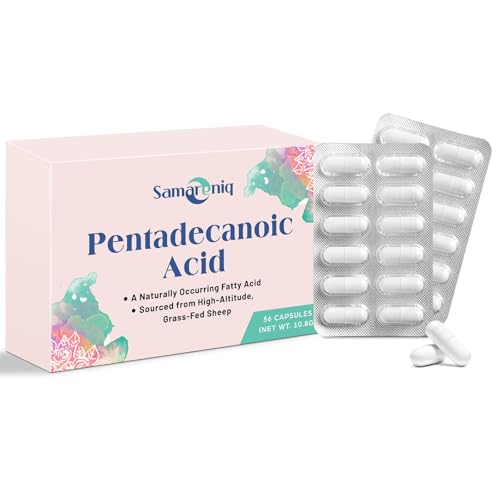
The two products shared 38 activities across 11 of the 12 systems, which the authors read as consistent, repeatable results.[1] Five of the 148 readouts differed between the products: CD40, secreted IL-17F, MCP-1, VCAM-1 and collagen III.[1] The authors say that may reflect real product differences or assay noise.
What the Cells Did
C15:0 was non-toxic to cells at every concentration tested, and showed 36 annotated activities in 10 of the 12 systems, mostly lowering inflammatory and fibrosis markers.[1] In systems that mimic cancer and fibrotic diseases, it slowed cell growth, for example in endothelial cells at 50 µM and 17 µM.[1] This is a cell-growth readout and not evidence of an effect on tumors in people.[1]
For more on how these lab findings relate to the proposed biology, see how C15 works in the body and our review of C15 and cancer.
The Comparison With EPA
EPA is one of the main fatty acids in fish oil. The study compared C15:0 with EPA at EPA’s top non-cytotoxic concentration of 17 µM.[1] Two inflammation markers fell with both fatty acids: both pentadecanoic acid and EPA lowered VCAM and MCP-1.[1] At the same concentration, C15:0 but not EPA lowered TNF-alpha, P-selectin, eotaxin-3, IP-10, MIG and IL-1 alpha.[1]
The counts of differences are not reported the same way everywhere in the paper. One passage reports 12 shared activities and 28 additional clinically relevant activities for C15:0, especially anti-inflammatory ones.[1] Another reports 12 common and 35 differentiating activities.[1] We cannot tell from the extracted text why the totals differ, so treat any single number with care.
On cell toxicity, EPA was cytotoxic to four cell systems at 50 µM, whereas C15:0 was non-cytotoxic at all concentrations.[1] The authors state a limit themselves: the study was limited to comparisons of C15:0 with EPA and no other omega-3 fatty acids, including DHA and alpha linolenic acid.[1] For the human-level comparison, see our page on Fatty15 versus fish oil.

Drug Look-Alikes: Pattern Matching, Not Treatment
The paper also reports that C15:0’s cell profile resembled those of known drugs. A “match” here means only that the cell-response pattern correlated at a Pearson coefficient of 0.7 or higher with a reference compound’s pattern.[1]
- At 1.9 and 5.6 µM, C15:0 had cell-based properties similar to bupropion (Pearson’s score of 0.78), a compound commonly used for depression and other mood disorders.[1]
- At the highest 50 µM concentration, C15:0 mimicked two anti-cancer drugs, gemcitabine and paclitaxel.[1]
- The authors extrapolate that approximate doses of 19 to 56 mg are expected to achieve circulating C15:0 concentrations with activities similar to bupropion.[1]
None of this shows that C15:0 treats depression or cancer. The bupropion link is pattern matching in cell assays, and the 19 to 56 mg figure is an estimate from cell data, not a tested dose.[1] The authors say as much: the cell-based studies are intended to predict outcomes that need to be tested in in vivo studies and clinical trials, especially those related to mood disorders and cancer.[1] Our page on C15 and mood covers the human evidence.
Funding, Patents and Commercial Ties
The work was funded by the Office of Naval Research through a small-business award received by an author and Epitracker, Inc. That author receives a salary from Epitracker, Inc. and Seraphina Therapeutics, Inc.[1]
The competing interests statement says the work is related to patents owned by the United States Navy or Epitracker, Inc., which have been licensed to Seraphina Therapeutics Inc. That company has a pentadecanoic acid (C15:0) food ingredient and supplement on the market.[1]
The authors also conclude that there is a need to reevaluate current nutritional guidelines that recommend lowering all dietary saturated fats.[1] That recommendation goes beyond what a cell screen can show, and it comes from authors with a commercial interest in pentadecanoic acid.[1]
Commercial involvement is common in nutrition science and does not by itself invalidate data. It is a reason to want independent replication, and to read conclusions about guidelines and products with extra care.

Why Cell Results Do Not Show Effects in People
- Healthy, pooled donors: each system used cells from 2 to 6 healthy donors, not people with a disease.[1]
- A narrow comparator: EPA only, not DHA or alpha linolenic acid.[1]
- Prediction, not proof: the authors say results must be tested in living animals and clinical trials.[1]
- Pattern similarity: a drug “match” is a correlation of cell responses, not a test of treatment.[1]
- Dose translation: the study’s own milligram figure is an estimate from cell data, not a tested dose.[1]
Where This Study Shows Up in Marketing
Company materials draw on the EPA comparison. Fatty15’s FAQ claims that, tested head to head against pure EPA, its product had 3x more cellular benefits, and says its own study found 26 additional clinically relevant benefits.[2] These are the company’s claims, they are cell-level comparisons, and the FAQ gives no human outcome data for them.[2] The company’s page also tells readers they may opt to use its product in lieu of omega-3 fish oil supplements, with no head-to-head human trial cited.[2]
The company’s own count of 26 differs from the 28 and 35 in the paper’s text, which is another reason to read the original data rather than a summary.[2][1]
The “essential fatty acid” claim travels alongside it. Trade press reports that the company calls C15:0 “the first essential fatty acid to be discovered in 90 years.”[3] Fatty15’s FAQ states the same thing, and no regulator is cited as having confirmed that status on the page.[2] This cell study did not test whether the body needs C15:0.
The essentiality idea comes from other work. A paper by authors linked to the supplement maker reported that C15:0 attenuated inflammation, anemia, dyslipidemia and fibrosis in animal studies, and proposed C15:0 as a potential essential fatty acid, which is a hypothesis and not an established fact.[4] An independent mini-review says pentadecanoic acid might meet both conditions to be described as essential, but that further investigations are needed.[5] For a fuller treatment, see Is C15 an essential fatty acid?.
The Bottom Line
In cells, C15:0 looked non-toxic across the doses tested and showed many anti-inflammatory readouts, and it did things EPA did not at the same concentration.[1] Those are interesting leads from a screen run by people with a commercial interest. They are not a reason to swap a fish-oil capsule for a C15:0 capsule. This page is not medical advice.
Frequently Asked Questions
Does this study show C15:0 is better than omega-3 fish oil?
No. It compared C15:0 with EPA in 12 human cell systems in a dish, and the authors say cell-based results are intended to predict outcomes that must be tested in in vivo studies and clinical trials.[1]
Was EPA toxic in the study?
In the dish, EPA was cytotoxic to four cell systems at 50 µM, while C15:0 was non-cytotoxic at all concentrations. That is a result in cells and not a statement about fish oil supplements in people.[1]
Who funded the cell study?
It was funded by a US Office of Naval Research small-business award received by an author and Epitracker, Inc. The work relates to patents licensed to Seraphina Therapeutics, which has a C15:0 supplement on the market.[1]
What does it mean that C15:0 matched bupropion?
It means the cell-response pattern correlated with bupropion’s pattern at a Pearson coefficient of 0.7 or higher. It is not evidence that C15:0 treats depression.[1]
Does this study prove C15:0 is an essential fatty acid?
No. The study measured cell responses and did not test whether the body needs C15:0. An independent mini-review says further investigation is needed.[5]
References
- Broader and safer clinically-relevant activities of pentadecanoic acid compared to omega-3: Evaluation of an emerging essential fatty acid across twelve primary human cell-based disease systems. PloS one, 2022
- Fatty15 FAQs. Fatty15 (Seraphina Therapeutics), 2026
- Recently discovered fatty acid ingredient, FA15, gets GRAS nod for food use. Nutritional Outlook, 2026
- Efficacy of dietary odd-chain saturated fatty acid pentadecanoic acid parallels broad associated health benefits in humans: could it be essential?. Scientific Reports, 2020
- New insights on pentadecanoic acid with special focus on its controversial essentiality: A mini-review. Biochimie, 2024
These statements have not been evaluated by the Food and Drug Administration. This information is not intended to diagnose, treat, cure, or prevent any disease. Content is for informational purposes only and is not medical advice; consult a qualified healthcare provider before starting any supplement. As an Amazon Associate we earn from qualifying purchases.